Showing posts with label Around Town. Show all posts

Wednesday, August 3, 2011

Wednesday, August 2 - A time of celebration and good memories


While it was a free day, much of it was spent finishing course journals and the slide show and preparing for the last get together at night in nearby Prebbleton.  We gathered together the students, lecturers, and friends - all essential in making our adventures successful and fun!  With thanks, we celebrated our time together and enjoyed the slide show of our New Zealand experience.  Collectively, we took over 10,000 photos in the past few weeks.  Some of us took over 1,000 in just one day.  Needless to say, creating a slideshow that captured the essence of our special time together is daunting.  We chose to go with basics and a few good laughs (like warm up exercises, reminders of killer-attack Weta, salt and pepper shakers, etc.) sprinkled in. And, we had an extra special glipse of a place few humans ever see/set foot -- Campbell Island.  Colin brought along a slide show of his remarkable summer adventure on this farthest south island of NZ.  Campbell Island is also the inspiration for the artwork on the Kiwi $5 bill.  You can learn more and see some of the wondrous plants and animals of this place (including the New Zealand Snipe) here.

Not wanting to think about going home, we relived memorable times together over the last five weeks.  Again, special thanks to our students for diving into our adventures with great enthusiasm, our guest lecturers for sharing their time and expertise, and our friends and families for their support.  Thanks also to our students for the special Koha treasures - very thoughtful and special.  Our time together, will be cherished.

Monday, August 1 - Hanging out with the Kiwis (finally!)

X-ray of Kiwi with egg inside.
Monday afternoon we experienced Willowbank Reserve.  Willowbank cares for New Zealand wildlife that occurs both naturally in the country as well as species that are part of the country's history (i.e., species that were introduced by colonists over time).  Some of these species are domestic such as chickens and horses, others have become pest species such as wallabies and possums.  The park seeks to educate residents and visitors as to the heritage and challenges New Zealand's animal species bring to the table.  Our tour also included native New Zealand species where we saw our first Tuatara, Kiwi, Takahe, and Morepork. 
Tuatara

Takahe

 (Here is what Henry, a 111-year old Tuatara that lives in Invercargill, looks like:)


We also got to size up the extinct animals of New Zealand that roamed this wondrous place not too long ago.
Katie and Emily with an "actual size" Moa sillhouette.  These were hunted to extinction in relatively recent history.

An additional tour was to experience Ko Tane - a Maori cultural performance.  Matt got to be our chief and made sure to let the Maori Village know that we came in peace by accepting their offering and performing a proper Hongi.


We all had a wonderful time, and our gals got to give Poi a go and 

our guys got to give the haka a go as part of the show.  

Experiencing the strong and beautiful singing voices of the women and men, watching them twirl poi and throw sticks, and seeing a true Haka were, again, amazing experiences.  

Following our tours we had dinner at a new restaurant in Lincoln, No. 6, and had a chance to thank Colin, Tupelo, Jamm and Meryl for their assistance with the course, and of course, the students for their enthusiasm and sense of adventure for making the course a success!
Colin, our honorary Gator! 

Sunday, July 31, 2011

Saturday, July 30th - Baby sheep with solar technology to gardens in the not-so-warm sun

This morning we visited a non-so typical NZ farm.  Graham's farm of fruit trees sports all the latest high-tech, energy-wise gadgets from the U.S.A. - solar panels that power his home, led lighting, a windmill in the works, Stirling Engine fan on the wood stove in the kitchen, etc. He even collects rainwater for all his home water use (i.e., drinking, flushing toilet, and showering).  We enjoyed our lesson that there is much we can all be doing in our own country to be oil independent and low impact on our environment.  We also really enjoyed seeing a little lamb born just two days earlier, and having tea with Graham and his wife, Karen.  Special thanks to both for their warm hospitality and for Karen's amazing and delicious spread of baked goods.


In the afternoon we braved a sunny, but cold day in the Christchurch Botanical Gardens with Colin Meurk as our expert guide of the Gardening with Indigenous Vegetation section.  It was fun to see that these native plants with so much texture can be used in not so formal as well as formal gardening with spectacular results.


Tomorrow we have a day of rest before setting off to Kaikoura for a day trip on Monday.


Cheers, Mark

Sunday, July 24, 2011

Snow Day(s) Sunday, July 24 and Monday, July 25

When it rains, it pours, or in this case, snows...

For those of you who are parents and friends and family that are following the blog, yes, we are supposed to be in Kaikoura today...

It has been 24 hours since our students were supposed to arrive back from their three-day free weekend in Queenstown; however, New Zealand has just experienced the largest and far reaching snow event in 20 years and all of the flights from Queenstown and Christchurch have been cancelled.  There has even been snow on the North Island which is highly unusual.  We have just received calls from the students that they are coming back via buses that are leaving now.  Everyone is fine, and we believe that they have had fun on their free weekend with the exception of the past 24 hours.  At least the airlines fed them well and put them up for the night.

Meanwhile, here in Christchurch, our kids are enjoying the snow (which at 2pm here is continuing to pour down). Yesterday at 2pm when our students were supposed to be arriving back, it started to snow with the sun out.  It did not last long and nothing stuck.

View from our flat Sunday, July 24 at 2pm as snow came down with the sun out.

Overnight; however, Christchurch even experienced ice and snow at the beaches and Lincoln University is closed.  Christchurch and Lincoln are usually only a bit more cold than Gainesville, FL in the winter, so to have snow, and in this quantity, is not a common event.  A resident friend here tells us every three years or so a sprinkling down to the level of the plains here is not unusual though.  Here is the same view from our flat  this morning:


We are bummed that everyone has to experience this unusual event and that it, once again, puts a wrinkle in our plans, but we hope that everyone remains bundled up and in good spirits.  Safe travels to all and we will post an update of the students safe arrival as well as our plans soon.

Stay tuned, and if you could, send some unusually warm weather from the States and we will send you some unusually cold weather from here! Cheers, Meryl : )

T and J with their "snowsheep" mid morning, Monday, July 25.

Sunday, July 17, 2011

Grubbing for Quail Island


Today was warm and sunny – perfect for a day on Quail Island!  Leaving bright and early for Lyttelton Harbor, we boarded our taxi for a quick 5-minute trip to the middle of the harbor.  


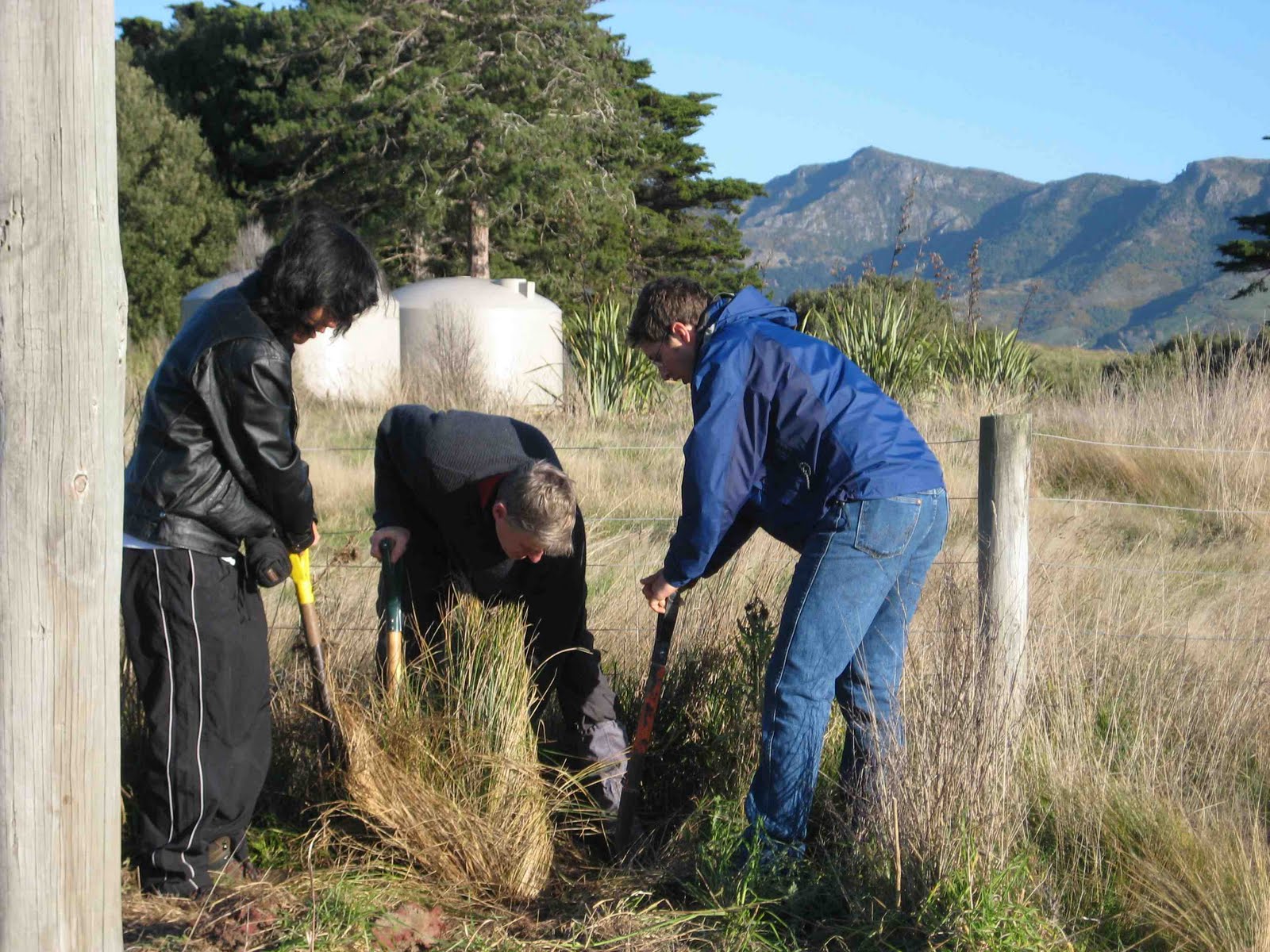
Once there, Colin Burrows and Ian McLennan explained a bit about the island restoration project and what we would be doing that day.  Moving tussock, staking up tussock, and grubbing (weeding off thick grass from sites where new native plants would be planted in two-week's time) were the requests for the day.  
moving tussock

supporting tussock

grubbing with Aua island in background

After a leisurely morning of work, we enjoyed a picnic on a hillside overlooking tiny Aua Island.  In the early afternoon, some of the students caught a catnap in the warm sunshine, while others went on a hike around the perimeter of the island. 

taking in the sun

taking in a hike

Throughout the day we all enjoyed taking in the various views of Lyttleton Harbor as well as seeing how previous plantings were thriving in their island environs.

taking in the view

native plantings thriving on the right

tussocks moved by last year's students are thriving!

a view of old shipwrecks

Tupelo helps demonstrate the Haka as we wait for our boat home

Tomorrow, we leave for the west coast! Get good rest and sweet dreams all, m : )

Saturday, July 16, 2011

Keas 45, Kiwis 20

Tena koe e te hoa (greetings my friends): It is week two and we have had some blustery weather that has changed our schedule a bit. The west coast has been wet and windy and the mountain passes have been covered in snow. Thus, we stayed on the east coast through the weekend. In Canterbury the weather has been fine and actually a bit warmer - sweet as! Today, we headed back to Travis Swamp to participate in a community restoration effort. After a morning spent planting natives and weeding, a first-ever cricket match was held (and we are not talking about insects!).

Each month, volunteers come out to Travis Swamp to help with ongoing efforts to restore Travis swamp. Travis is the largest urban wetland in the Christchurch area and it truly takes a community effort to keep things going. We headed out with our intrepid leader (Dr. Colin Meurk) and met up with some local volunteers. We grabbed some grubbers (kiwi for hoes) and some shovels - cleared some grass, and dug many holes. It as a bit soggy out in the swamp as Kinsley and Ally found out (check out Ally's foot!). Colin demonstrated proper planting techniques and we planted approximately 55 plants.

Whoops - a bit muddy!

Alexis and Scott in action!

Peter and Jane

Colin demonstrating proper planting technique

Working up an appetite, we met with the other volunteers for tea at the visitor center and then headed to the "Naked Baker" - a local pie shop (these are meat pies). Filled with yummy pies, we visited New Brighton beach where Colin described restoration efforts along the dunes. The sun came out and a few of us frolicked on the beach.


Beach!

We even crossed the road and tried out the flying fox!

No fun had here!

Back at Lincoln, we headed to the domain (aka sports field). We split into two teams, (Kiwis vs. the Keas) and commenced the cricket match (albeit, a somewhat modified version). In this game, we have bats, bowlers, wickets, overs, wicket keeper, bails, leg-before-wickett, a googlies, and various other terms related to cricket. Essentially, you bowl (pitch) the ball towards the wicket and try to knock the bails off while the batsman defends the wicket. After several overs, the final score was Keas 45 and Kiwis 20.  Ahhh - now we nurse our shoulders and ankles. Haere ra! Dr. H

Cricket at the domain!

Friday, July 15, 2011

Thinking green on a brisk New Zealand day

Kia Ora!

Today was a jam packed day full of interesting lectures encompassing ideas behind ecosystem restoration, sustainability, and green developments. We even got to visit a Ngai Tahu land development. The Ngai Tahu are a southern New Zealand Maori tribe. We have been fortunate enough to have met so many fascinating and cultured lecturers that are so equipped with knowledge of their fields!

Today we started off the morning listening to Colin Meurk speak to us about Ecosystem Restoration Theory and Principles. We learned the importance of restoring the New Zealand ecosystems since the landscape has lost so much of its indigenous components. In addition, we learned the seven dimensions of Ecological Restoration, which involves a full spectrum of interactions from socio-political considerations to biodiversity elements.

 Next, we took a tea time break and then returned for a lecture on Solutions for Creating a Sustainable Culture, by Dr. Will Allen. His lecture was very interactive and got us all using our creative minds to come up with what we think sustainability is and how to convince people to incorporate it into their lives. We broke into two groups and brainstormed how we see a sustainable community would be and how the people in it would respond and measure their success in life. We all decided that there must be an outreach of sustainable education early in one's life. Parents' interactions with their children early on are extremely important in raising an environmentally friendly generation.

After lunch we listened to Dr. Hostetler lecture on the Post- Construction aspect of conservation and management. We learned about the potential problems and the need for educating residents and readily providing them with the information regarding living in a green friendly community.

Finally, we headed out to a Ngai Tahu housing development and met with David Schwartfeger, a project manager for the Ngai Tahu developing agency. He spoke about the land that is envisioned to provide for a green friendly neighborhood. Half of it has already been built on, and they will soon have running paths, trails, and a park. Unfortunately, as we have learned, all of these certified green developments have their issues. He spoke how they monitor the silt and particle formation into the water and provide new homeowners with information regarding their responsibilities in living in a green community and the regulations they must follow. David emphasized the importance of communication and the hope to instill the sense of sustainability in the residents' minds. They do this by checking up on them for years after the development has been built and marking the community and wetland area with signage providing wildlife information. After this we headed back to Lincoln University to escape the brisk outside temperature!  Tonight some of us are going to go to a concert, which is part of the Winter festival that is held at the university the first week of the new term!


Hope all is well back in the states!

Cheers!
Kinsley

Thursday, July 14, 2011

Harry Potter and Sustainable Design

Kia ora koutou!

Today we had a few lectures and a mini field trip to the Liffy in Lincoln, followed by Harry Potter and the Deathly Hollows, Part II.

Dr. Hostetler lectured about designing and constructing sustainable developments. The design aspect is comprised of three phases: design, construction, and post-construction. It is important to note that during all 3 phases one must keep design and management practices in mind in order to reach a successful completion. The most successful technique of design is the low impact urban design and development plan, or LIUDD. This plan incorporates many aspects into the design of a sustainable urban area, such as:
  • focus development on previously disturbed sites
  • providing habitat for wildlife
  • use established ecological principles
  • preserve high quality natural areas
  • create a network of open space
  • create green transportation
  • consider nearby habitat and people
  • conserve wetlands and wetland buffers
  • enhance Maori values
Constructing with these aspects in mind helps to reach the goal of improving the biodiversity on the building site and create minimal impacts on nearby habitat.  To see examples of the different methods of implementation of design and construction, we took a small class trip to the Liffy, a neighborhood just east of the Uni.

Use of a buffer of native vegetation between wildlife areas and wetlands from residential housing
Native vegetation planting
By far, Max's expression in the back is the best. He is really excited about visiting the Liffy

Use of retention/detention ponds as a wildlife area


Robert Watts, a water conservation manager from the Landcare Research Center also gave a lecture about different water management successes and failures in the Christchurch area.  Many of the successes were due to legislation passed in New Zealand that resemble the Comprehensive Growth Management Act and Area Planning policies in the United States.  Overall, it was a very informative presentation.


In the evening, Dr. Hostetler took us out for a movie night to see Harry Potter and Deathly Hallows Part II in Christchurch.  I swear I only choked on popcorn, and not the touching scene in the middle of the movie! We thoroughly enjoyed our night, and are excited for the lectures in the morning, although we got back way past our usual bedtime.

Whakamaoritia!

Alexis


Wednesday, July 13, 2011

Wednesday, July 13th

Today was a free day and our students got to enjoy some time off to rest, explore the area, catch up on laundry, etc.

The day had plenty of news, however:

A big dump of snow in the Southern Alps is once again forcing us to shift our course schedule around.  This after the “warmest winter in 50 years” and “no snow” in the weeks before our students arrived!

There was a fire at Hinewai the afternoon after we left the reserve. We saw (and drove through) the swiftly moving lightning storm that started it as we left the Okains Bay area on Tuesday.  We spoke with Hugh Wilson on Wednesday evening after firefighters were able to contain and extinguish the blaze around 4pm and he was in good spirits considering all that had occurred.

The price of tomatoes is up to $14.99/kilo. Where we might pay $5 for a container of tomatoes  when they are “expensive,” here the same container runs $8.99.


Speaking of expensive, gas is still expensive this side of the world.  It costs almost $100 to fill up a tank for a mini-van.

And, New Zealand is facing similar economic conditions as in the USA.  This week, the government is in the process of debating implementing a capital gains tax.


-m&m


Saturday, July 9, 2011

From Markets to Fish (Saturday, July 9th)

We spent the morning sampling fresh produce and local delicacies at the Riccarton Market followed by an hour shopping trip to stock up on warmer clothes.  Next it was off to sample our first take-aways Fish and Chips.


We spent the afternoon at Sumner Beach at Cave Rock.  We even got to see a baby seal!  Tomorrow we leave for our three day adventure at Hinewai Reserve.

- Mark